
Open-Ear vs Bone Conduction vs Air Conduction: What the Labels Actually Mean
The labels get thrown around as if they were interchangeable. They describe two completely different ways of getting sound into your head — and picking the wrong one is the fastest way to end up disappointed in a pair of earbuds you just spent $150 on.
Walk into any headphone aisle in 2026 and you will see three phrases printed on the boxes: open-ear, bone conduction, air conduction. They are often listed side by side, as though they were features you could stack on top of each other. They are not. Two of them describe a mechanical principle. One of them describes a shape. Confusing the three is how people end up buying a bone conduction headset expecting bass, or a clip-on expecting to wear it in a swimming pool.
Here is the clean way to think about it.
The only split that matters: does it vibrate your skull, or aim at your ear?
Every product in this category does one of two things. Either it vibrates the bone in your head, or it fires sound at your ear canal from just outside it. That is the whole distinction. Clip-on, ear-hook, neckband, “open-ear” — all of that is packaging that sits on top of one of those two principles.
Bone conduction: it never touches your ear at all
A transducer sits against the bone just in front of your ear and vibrates it. That vibration travels through the skull into the cochlea, skipping your eardrum and your ear canal entirely. Your ear is doing nothing except being adjacent to the sound.
What that buys you: an ear canal that stays completely open and completely untouched. That makes bone conduction the only sensible option if you swim, if you wear earplugs for work or for noise, or if you genuinely cannot tolerate anything sitting in or over your ear for hours. It also simply cannot fall out, because it was never in.
What it costs you: bass, mostly. Moving bone is far less efficient than moving air, so bone conduction drivers need a great deal of power to produce anything below roughly 100Hz, and most designs do not seriously try. Turn the volume up and the transducer’s vibration becomes audible to whoever is sitting next to you. And it needs firm, steady contact: sunglasses arms, a hat, or a loose band all break the coupling, and the sound thins out the instant it happens.
Air conduction, which is what “open-ear” almost always means
A small directional driver sits outside your ear canal and fires into it. Nothing is inserted — but the sound still travels through air, exactly like a conventional headphone. This is what the overwhelming majority of things marketed as “open-ear” actually are, and it splits into two shapes worth understanding.
Ear-hook. A hook wraps over the top of your ear and holds the driver in front of the canal. The bigger housing allows a bigger driver and a bigger battery, and because the driver sits closer to the ear, bass is stronger. The trade-off is visibility — it is on your face, and it is not subtle.
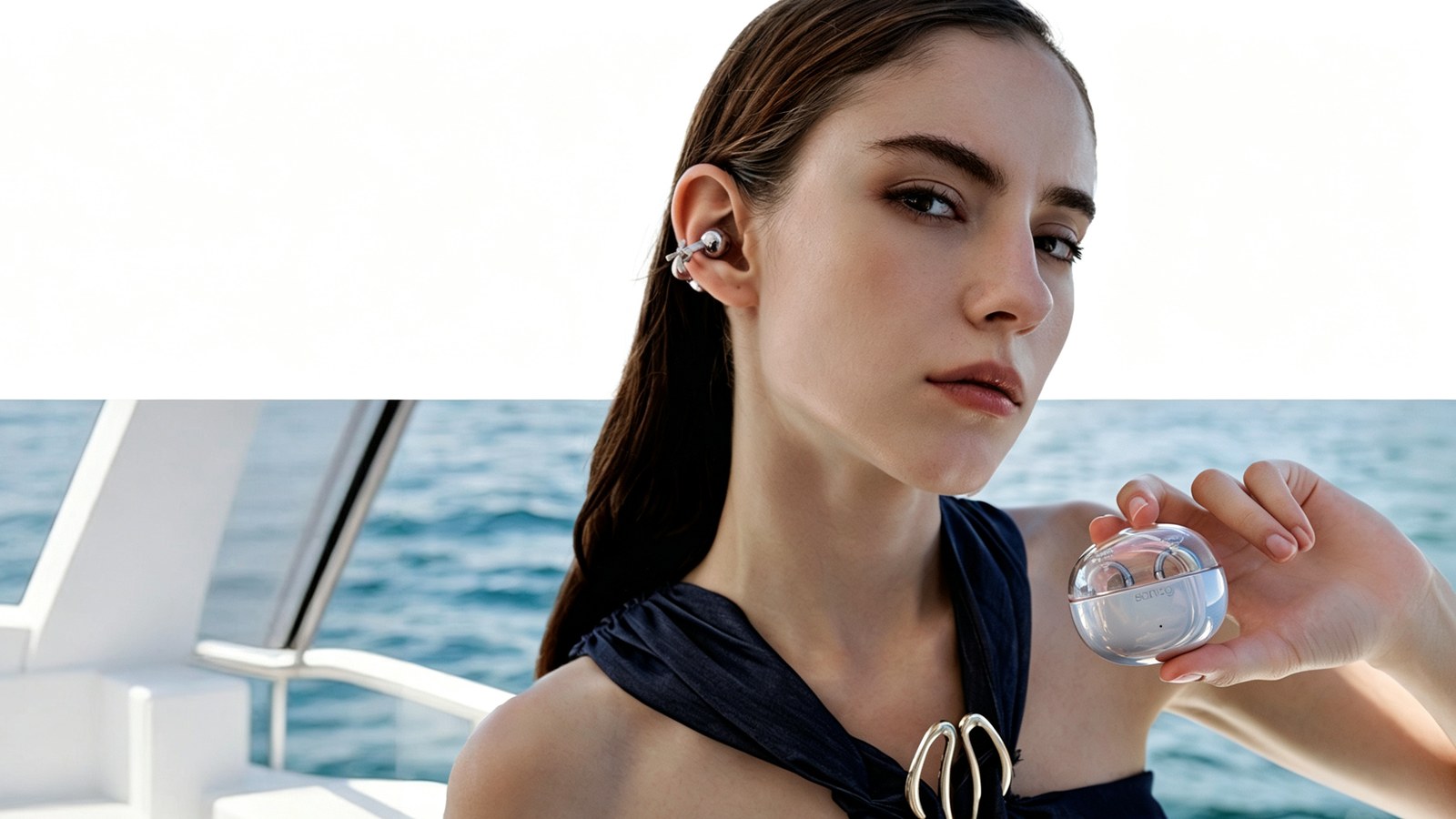
Clip-on. A clamp grips the cartilage of your outer ear. No hook, no band. It is the most discreet thing you can put on your head, it does not fight with glasses or a hat, and it disappears under hair. Because the driver sits a few millimetres further from the canal, bass is leaner than on the best ear-hooks — though that gap has narrowed sharply over the last two years, and clip-on is now the shape most people should start with.
Side by side
| Bone conduction | Ear-hook open-ear | Clip-on open-ear | |
|---|---|---|---|
| How it works | Vibrates the skull, bypasses the ear canal | Speaker outside the canal, aimed inward | Speaker outside the canal, clamped to the ear |
| Bass | Weak — the physical limit of the design | Strongest of the three | Good and improving fast |
| Stays put in hard activity | Excellent | Excellent | Very good |
| Comfort after eight hours | Depends entirely on band pressure | Good, but you feel it | Best — most people forget they are wearing it |
| Visible to other people | Yes, always | Very obvious | Barely |
| Works with earplugs in | Yes | No | No |
| Buy it if | You swim, or you need your ears physically clear | You run or ride and want the best sound available | You wear glasses and live in them all day |
Three things people get wrong
1. “Open-ear means no bass.” This was true in 2019 and it is not true now. Air-conduction open-ear designs have quietly solved most of the bass problem through larger drivers, sealed acoustic chambers and better positioning. A good clip-on today delivers enough low end for pop, hip-hop and podcasts. It will still lose to a sealed in-ear on the very bottom octave — that part is physics and it is not going away.
2. “ANC on an open-ear earbud is the same as ANC on a sealed one.” It is not, and the difference is worth understanding before you spend money. Noise cancelling works by sampling outside noise and playing the inverse of it. On a sealed earbud, that noise is already blocked by the tip, so the electronics only have to deal with the residue. On an open design there is no seal to help, so the system can only cancel what its microphone and driver can actually reach — realistically the low rumble of engines and air conditioning. Apple’s AirPods 5 claims up to 50% more external noise removed than AirPods 4 with ANC, and that is a real gain. It still does not make an open earbud a substitute for a sealed one on a long flight. That is not marketing being dishonest; that is the design being honest about arithmetic.
3. “They all leak the same amount.” Leakage is a design decision as much as a physical constraint. Driver size, chamber sealing, how far the driver sits from the canal and how directional it is all move the number, and the spread between a careless design and a good one is obvious to anyone sitting beside you on a train. If you take calls in shared space, leakage is the spec to care about — ask about it directly rather than trusting the phrase “open-ear” to tell you anything.
So which one is actually yours?
Skip the marketing and answer one question: what are you doing while you wear them?
If you swim, or you need your ear canals physically clear for earplugs, or you have never once had an earbud stay in during a sprint — bone conduction. If you run or ride and want the best sound you can get while still hearing traffic — ear-hook open-ear. If you wear glasses, sit in calls most of the day, and want something nobody notices you are wearing — clip-on open-ear. And if what you actually want is silence on a plane, none of these three is the answer; buy a sealed earbud with good ANC and stop reading.
Where we come in
We sell sanag, which is worth mentioning precisely because clip-on is the shape most people should start with. The sanag S8S Ultra is a clip-on at $159.99 that adds two-way face-to-face translation and simultaneous interpreting through the sanag app — genuinely useful if you travel or work across languages, and unusual at this price. If you want the same shape with a published 40-hour battery, a 13.4mm titanium-plated driver, dynamic spatial head tracking and 99% less sound leakage, step up to the sanag S9S AI at $199.99.
We don’t claim either of them wins on bass against the best ear-hooks — they don’t, and no clip-on does. What they win on is the thing clip-ons exist for: wearing them for a whole day and forgetting they are there. You can see the rest of the range on the sanag brand page, or read our field notes on what Apple’s $129 open-ear ANC actually does and what happens when the same idea goes open-back.
If you would rather just see the shortlist, we keep a running buying guide to the best open-ear earbuds under $200 — updated with prices checked on the manufacturers’ own stores.
Micproduct’s guides are written by people who sell, install and live with this gear. We name our own products and our competitors’, and we tell you when the other one wins. No sponsored rankings, ever.