
Dolby Atmos 7.1.2 Explained: What the Numbers Actually Mean
7.1.2, 5.1.2, 7.1.4 — the numbers on a soundbar box are the only honest specification in the entire category. Here is what each one actually promises you, and why the last digit is the one that decides whether you hear anything above your head.
Most people shopping for a soundbar learn two words — “Dolby Atmos” — and stop there. That is exactly the problem. Atmos is a decoding format, not a hardware specification. A $150 single bar with two drivers can decode it. So can a $1,200 system with fourteen drivers. Both can print the logo on the box, and only one of them will put rain above your sofa.
The three-number code is how you tell them apart. Once you can read it, most of the marketing noise disappears.
The three numbers, in order
A channel configuration reads as bed.sub.height. First digit: how many ear-level channels surround you. Middle digit: whether there is a dedicated subwoofer for low frequency. Last digit: how many speakers point up or sit in your ceiling.
| Config | What you actually have | Overhead sound? |
|---|---|---|
| 2.0 | Left, right | No |
| 2.1 | Left, right, subwoofer | No |
| 3.1 | Left, centre, right, subwoofer | No |
| 5.1 | Front three, two surrounds, subwoofer | No |
| 5.1.2 | The above plus two height channels | Yes — two positions |
| 7.1.2 | Seven ear-level channels, subwoofer, two height channels | Yes — behind you as well as above |
| 7.1.4 | Seven ear-level channels, subwoofer, four height channels | Yes — front and rear overhead |
| 9.1.6 | Nine ear-level, subwoofer, six height | Yes — full overhead dome |
Two clarifications that trip people up. The “.1” is not a speaker position, it is a channel of content — everything below roughly 80Hz. And the bed channels in a 7.1 layout are not “seven speakers you can see”: in a soundbar they are usually reproduced by driver arrays and steering, in a proper speaker package by seven physical boxes.
Why the last number is the one that matters
Dolby Atmos is object-based audio. Instead of baking sound into fixed channels, the mix carries audio objects with positional metadata, and the renderer in your soundbar or receiver decides which of your speakers should play each one. The practical consequence: the renderer can only place sound where you have speakers.
A helicopter that should track across your ceiling has nowhere to go in a 5.1 system. The renderer will do its best to fake it — pushing the effect across the front stage and hoping your brain fills in the rest — but there is no speaker above you, so there is no sound above you.
That is the entire difference between “this bar supports Atmos” and “this bar does Atmos.” When people describe the format as underwhelming, nine times out of ten they are listening to a system without a real height layer. Add two drivers aimed at the ceiling and the same demo suddenly works.
How up-firing drivers actually work
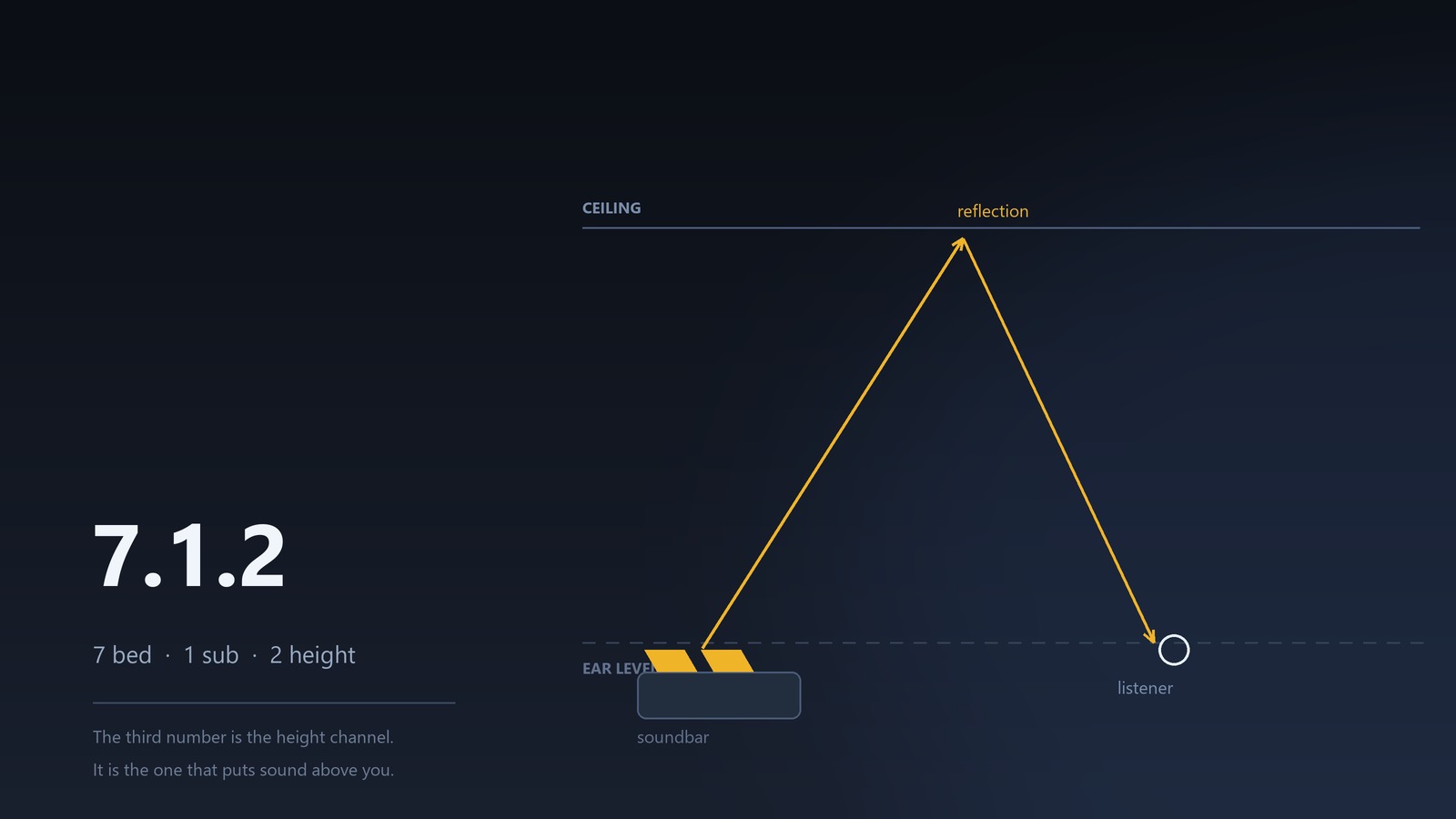
Since cutting holes in a living-room ceiling is rarely an option, most Atmos soundbars create the height layer indirectly. Angled drivers on top of the bar fire upward; the sound hits your ceiling and reflects back down to the listening position. Your ears read the arrival as coming from above, because the last thing the sound did was bounce off the ceiling.
The physics has consequences worth knowing before you buy:
Ceiling height and shape. Up-firing works best with a flat, reflective ceiling in a normal domestic range. Sloped ceilings, beams, ceiling fans and heavy acoustic treatment scatter or absorb the reflection, and the effect degrades fast.
Distance. The geometry assumes you are sitting at a reasonable distance from the bar. In a small room where you sit close, up-firing can work unusually well; in a large room where the sofa is ten feet back and the ceiling is high, the angles stop lining up.
Volume. Reflected sound is quieter than direct sound by the time it reaches you. At low listening levels the height layer is the first thing to disappear — which is why people who test Atmos bars in quiet showrooms come away unconvinced.
“Atmos” without height channels: what virtualisation really is
Here is the part the industry is least eager to explain. Plenty of soundbars decode Dolby Atmos but have no up-firing drivers at all. Instead they apply processing — Dolby Atmos Height Virtualization, or DTS Virtual:X in the DTS world — that attempts to create the sensation of overhead sound from front-firing speakers only.
It is not a lie and it is not nothing. It can widen the stage and make a movie more enveloping. But it is a simulation of a physical layer you do not own, and you can hear the difference the moment you A/B it against real height drivers. If you want to spot it in a spec sheet, look for the tell: bars that rely on virtualisation advertise “Dolby Atmos and DTS Virtual:X” and never once use the words “up-firing.”
Two verified examples from the current US market, checked on the manufacturers’ own stores: JBL’s Bar 300MK2 ($449.95), Bar 500MK2 ($399.95) and Bar 700MK2 ($549.95) all carry the Atmos badge and all describe their surround processing as DTS Virtual:X — their spec sheets do not claim up-firing drivers. In JBL’s line the up-firing hardware starts at the Bar 1000MK2, $749.95, sold as a 7.1.4 system. Bose draws the same line: the $999 Smart Ultra Soundbar is the one Bose describes as having two upward-firing dipole speakers; the $549 Smart Soundbar is not described that way.
None of that makes those bars bad products. It makes them not-height-channel products, and knowing that before you spend $500 is worth more than any review score.
The source matters as much as the speakers
Three things have to line up before you hear Atmos at all, and the speakers are only one of them.
The stream has to carry it. Streaming Atmos travels as Dolby Digital Plus with Atmos metadata — compressed, but genuinely object-based. Disc-based Atmos on 4K Blu-ray is Dolby TrueHD: the same objects, lossless. Same format, noticeably different result on a good system.
The connection has to carry it. HDMI eARC (enhanced Audio Return Channel) is the one mainstream link that passes full-quality Atmos from a TV to a bar. Optical cannot carry Atmos at all — it does not have the bandwidth or the protocol support. Bluetooth cannot either, at any bitrate. If your plan is “TV out to the bar with an optical cable,” your plan is 5.1 with the height layer dropped on the floor.
The content has to have it. Atmos mixes are now standard for most new film and series releases on the major streaming platforms, but not every tier and not every device gets them. Your console or streaming stick, your TV and your subscription level all have a say.
The sixty-second spec check
Before you buy anything with an Atmos logo, find these four things in the manufacturer’s own documentation:
1. The words “up-firing,” “height” or “elevation.” If the copy talks only about “3D surround” and “virtualisation,” there is no physical height layer.
2. The channel code, in full. A 5.1.2 system can be honest and excellent. A 5.1 system cannot be a 5.1.2 system, whatever the badge suggests.
3. Whether the subwoofer is included. A “.1” in the model name does not guarantee a sub in the box. Some bars reach their rated low-frequency figure only with an optional subwoofer that is sold separately.
4. HDMI eARC, on both ends. Your TV and the bar both need it. This is the single most common reason an Atmos system sounds like a normal soundbar.
What real height costs right now
Verified against manufacturer stores in September 2026, here is where the floor actually sits:
| System | Config | Height layer | Price |
|---|---|---|---|
| JBL Bar 500MK2 | 5.1 with 10″ sub | Virtualised (DTS Virtual:X) | $399.95 |
| JBL Bar 1000MK2 | 7.1.4 with detachable surrounds | Real, up-firing | $749.95 |
| Bose Smart Soundbar | Single bar | Not described as up-firing | $549 |
| Bose Smart Ultra Soundbar | Single bar | Real, two upward-firing dipoles | $999 |
| Jamo HCS B5 | 5.1.2 with 8″ wireless sub | Real, up-firing teardrop units | $499 |
| OXS Thunder Pro+ | 7.1.2, ten drivers | Real, two up-firing sky channels | $699.99 |
We sell two of the six systems in that table, so read the rest of this paragraph knowing that. The pattern is still worth seeing plainly: real height channels start around $499 from a specialist speaker brand, and the mainstream consumer brands charge $750 to $1,000 before they put up-firing drivers in a box.
The Jamo HCS B5 is a genuine 5.1.2 system — thirteen drivers in the bar, two of them up-firing, plus an 8-inch wireless subwoofer that is included rather than optional — for $499. The OXS Thunder Pro+ at $699.99 is a 7.1.2 layout tuned for gaming rather than film, with ten drivers including two up-firing sky channels, game modes that lift footsteps above the mix, and the option to add an 80W subwoofer later if you want the low end to reach 38Hz. Its low end without that sub is the honest compromise, and you should know it before you buy.
Three questions we get asked weekly
Is 5.1.2 enough, or do I need 7.1.2? If your priority is film, 5.1.2 with a real subwoofer beats 7.1.2 without one. If your priority is competitive gaming, the rear channels earn their money — that is where positional information lives when someone is behind you.
Will an Atmos bar work in a small flat? Usually better than people expect, provided your ceiling is flat and you sit fairly close. Small rooms are harder for bass and easier for height reflection.
Do I need a receiver? Not for any system in the table above. A receiver is for passive speaker packages, where the speakers have no amplification of their own. Soundbars and all-in-one systems carry their own amplification and decoding.
Next, read how to actually connect and configure this for a console or PC — because the most common failure is not a bad bar, it is a bad signal path. If you are still deciding at the category level rather than the spec level, our soundbar buying guide and budget Atmos roundup cover the rest, and this guide to building 5.1.2 without renovating is for anyone who would rather use real speakers than a bar.
Picking a specific system? Our Jamo HCS B5 review walks through a $499 5.1.2 setup box by box, including what it cannot do. Our own systems are on the OXS and Jamo brand pages.
Micproduct’s guides are written by people who sell, install and live with this gear. We name our own products and our competitors’, and we tell you when the other one wins. No sponsored rankings, ever.