Samsung Galaxy Buds On, T1 and H1: Three Leaks, Three Different Jobs
Samsung has leaked three audio products in a single day: a clip-on earbud, an ear-hook sports bud and an over-ear headphone. None of the three is trying to be the best-sounding Galaxy Bud, and that is the actual news.
Where this comes from
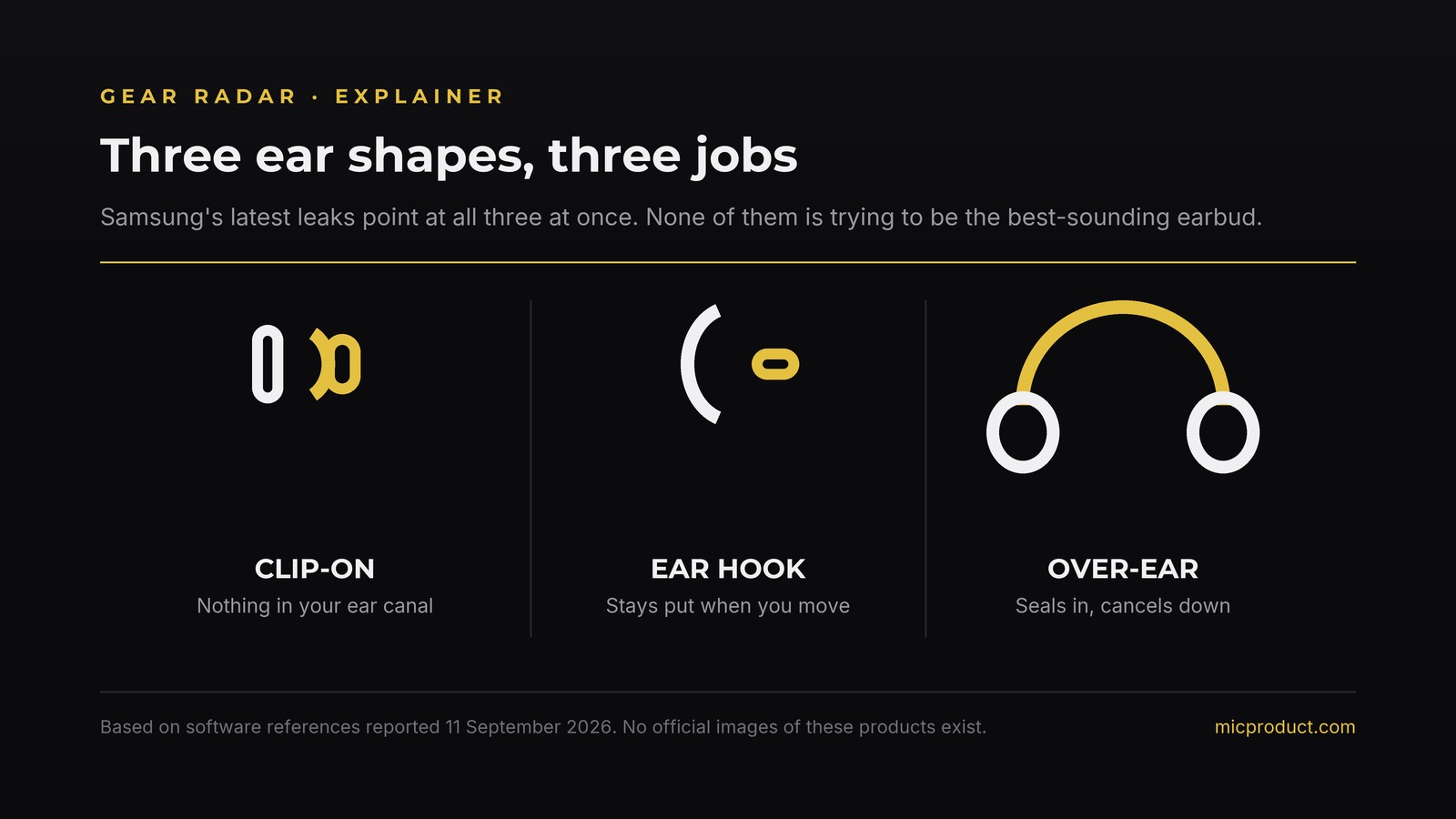
All three surfaced out of software rather than supply-chain photos — reference strings found in a One UI release and an app package by SammyGuru. Samsung’s own files describing Samsung’s own unreleased products, which makes the details unusually specific and the products entirely unconfirmed. None has been announced, and no official images exist, which is why the graphic above is a diagram and not a photo. Read what follows as reported intent, not specification.
Galaxy Buds On: the clip-on
This is the one that breaks a pattern. For a decade the Galaxy Buds have all been the same idea: something pushed into your ear canal. The Buds On appear to drop that entirely. Two rounded sections joined by a flexible loop, one resting inside the ear and the other outside it, so the bud hugs the ear instead of plugging it. The outer section carries a concave touch surface, and black and white versions both show up in the Buds Manager app.
The feature list looks like a normal Galaxy Bud with one deliberate hole punched in it. Auto Volume adjusts playback as your surroundings get louder and quieter; a separate Volume Boost trades privacy for loudness, meaning people nearby will hear it. Head gestures from the Buds 4 series carry over, Gemini or Bixby can be summoned by voice or touch, and the same shortcut starts a voice memo that gets transcribed afterwards. What is absent tells you more: no active noise cancellation, no 360 Audio with head tracking. Rumours point to a Q4 2026 debut.
Galaxy T1: the ear hook
Model number SM-R545, and the brief is legible from the shape — a full hook wrapping the outside of the ear, for running and gym work where the failure mode is not sound quality but a bud working itself loose mid-session. The references show customisable touch-and-hold gestures per side: holding the left bud lowers volume by default, the right raises it, and either can be reassigned to reject calls or switch noise modes. An advanced audio-quality menu appears in the files too, but with no confirmed codec, no 24-bit/96kHz claim and no lossless. Two 63mAh cells and a 595mAh case are listed, with no runtime figures to make sense of them.
Galaxy H1: the over-ear
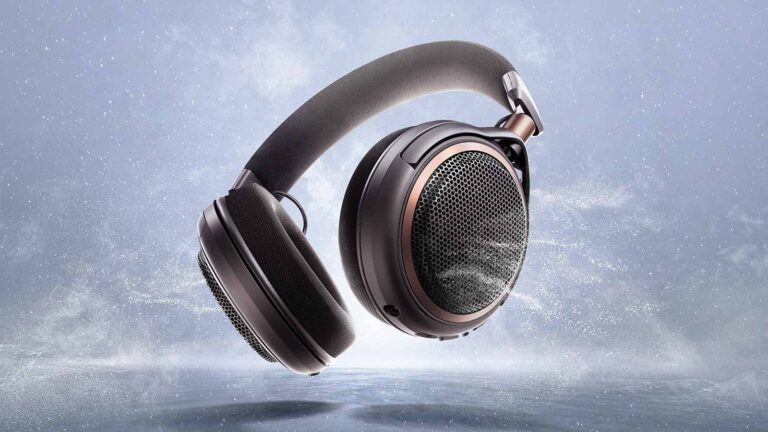
Samsung’s first over-ear headphones since 2015, pointed straight at the Sony WH-1000XM line and the AirPods Max. Physical buttons plus a capacitive touchpad on the right cup, and a button on the left cycling noise-cancellation modes — the software asks users to pick at least two, so an adaptive mode is likely. Ambient is a double-press. A Conversation mode drops cancellation and suppresses your media when somebody starts talking, then fades back a few seconds after they stop. 360 audio with head tracking is indicated; head gestures for playback are not. There is also an auto-off timer with 30-minute, one-hour and two-hour settings.
Why three shapes matters more than three products
For most of the last decade Samsung sold one shape and one argument: in-ear, sealed, cancelled. Apple’s AirPods 5 made the opposite bet at $129 and Audio-Technica’s ATH-AL5NC made a version of it in full-size headphones. Both assumed listeners would trade isolation for an open presentation. Samsung is now making that bet three times at once, in shapes matched to three jobs: all-day wear, movement, travel. The range stops being a ladder with a best rung and becomes a set of specific answers, which is harder to shop from, because “which earbuds are best” stops being the right question.
What to do with this
Nothing here is buyable today: Q4 2026 is the only timing on the table, for the Buds On, and nothing firm for the other two. So buy for the job you actually have. If you want your ears open for a colleague, a traffic light or your own name, clip-ons have been answering that for a while — our explainer on the open-ear labels covers what the categories really mean, and the under-$200 guide covers what is worth buying. The sanag S9S is the all-day clip-on we sell; the S8S Ultra adds two-way translation to the same fit.
One limit is worth repeating, because these leaks invite the wrong comparison. An open-ear design cannot cancel noise the way a sealed one does — there is no seal for the electronics to work against, so every decibel has to be generated from nothing. That is why the Buds On leak lists no ANC while the H1 leak lists several cancellation modes. The shape decides the features long before the software does. If a quiet flight is what you are buying, buy a seal.
Gear Radar is our editorial corner: buying guides, reviews and tutorials for people who care about how things sound. No sponsored rankings, ever.