
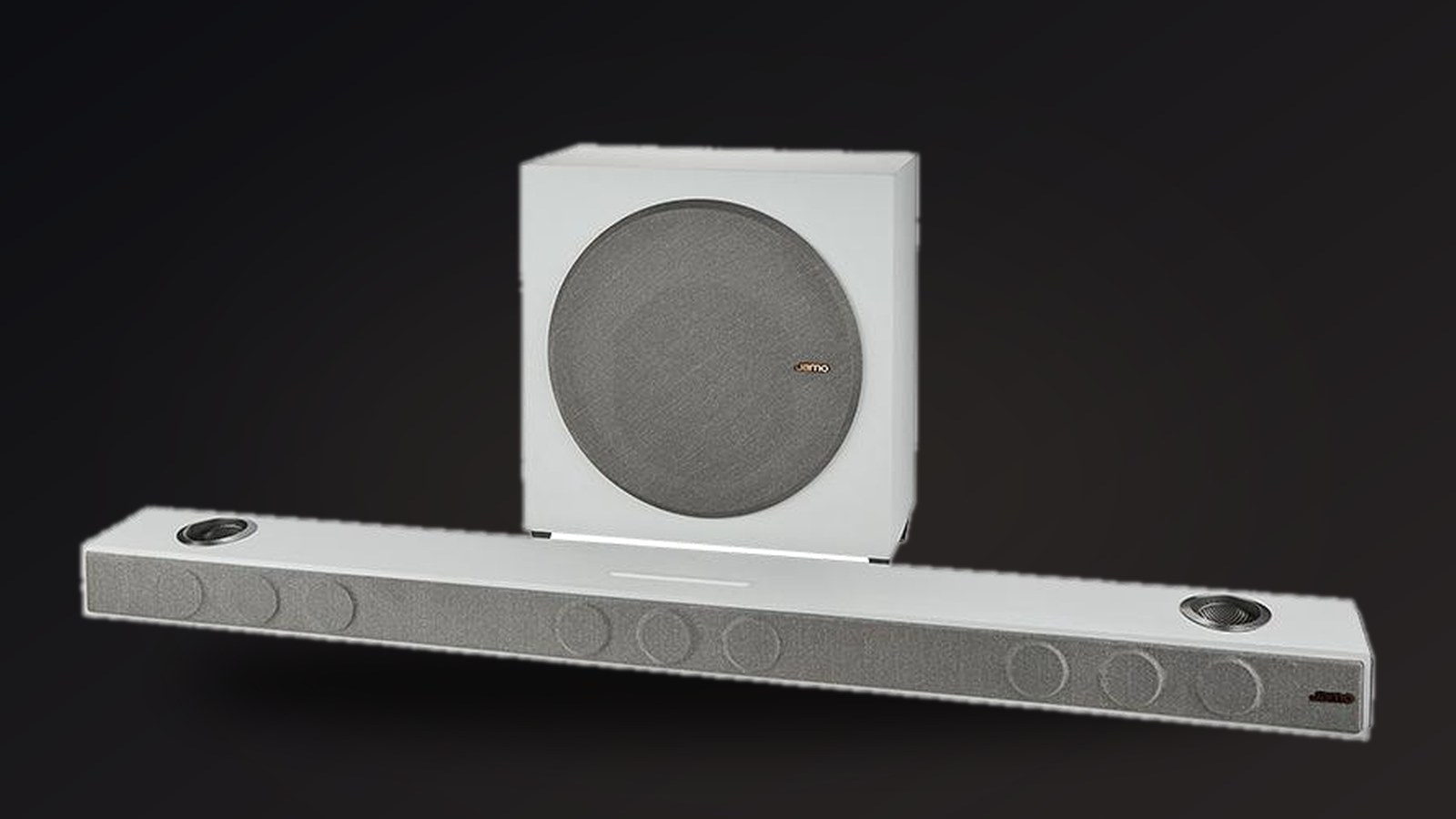
Jamo HCS B5 Review: What $499 Buys You in a Real 5.1.2 Dolby Atmos System
A 5.1.2 Dolby Atmos system with thirteen drivers, real up-firing height units and an eight-inch wireless subwoofer, for $499. We sell this one, so read the parts where we say who should not buy it.
The Jamo HCS B5 is the cheapest system we sell that produces a genuine height layer rather than a convincing impression of one. That single sentence is the whole review. Everything below is either the evidence for it or the reasons it might still be the wrong box for your living room.
We are a dealer, not a test lab. We do not publish frequency-response graphs we did not measure. What we can tell you honestly: what is in the box, what the published specifications say, what breaks in real rooms, and which customers come back happy.
What $499 actually buys
Two boxes. A 1,240 mm soundbar with thirteen drivers — including the teardrop up-firing Atmos units at each end — and a wireless eight-inch subwoofer. Nothing else is required: no receiver, no amplifier, no speaker cable. The sub links to the bar over a 5.8 GHz connection, so it needs a power socket and nothing else.
The height layer is physical hardware, not processing. The up-firing units push sound at your ceiling and the reflections arrive from above your head. Jamo developed the horn tweeters doing that job with Rayleigh Lab, and the ceiling-reflection geometry is patented. This is the part of the spec sheet worth paying attention to, because it is the part most bars at this price fake.
| Channels | 5.1.2 (soundbar + wireless subwoofer) |
| Drivers | 13 in the soundbar, plus one 8″ subwoofer driver |
| Power | 420 W total |
| Frequency response | 40 Hz – 20 kHz |
| Height layer | Up-firing teardrop units, ceiling-reflection horn tweeter |
| HDMI | 2 × HDMI 2.1 in, 1 × eARC out, 4K & Dolby Vision passthrough, CEC |
| Other inputs | Optical, 3.5 mm analogue, Bluetooth 5.0 |
| Wireless sub link | 5.8 GHz multi-channel |
| Sound modes | Standard / Movie / Music / Night / News, plus per-channel level tuning |
| Cabinet | Wooden enclosure, fabric grille, VFD display |
| Dimensions | Soundbar 1,240 × 97 × 136 mm · Subwoofer 410 × 410 × 249 mm |
| In the box | Soundbar, subwoofer, remote (batteries included), sub power cord, soundbar power adapter, optical cable, HDMI cable |
The four specs that change a buying decision
Real up-firing units, not virtualised height. Every bar at $300–$500 will happily print “Dolby Atmos” on the box. Most of them mean the bar decodes Atmos and then approximates the height layer in software. That is a defensible trick, and it is not the same product. The B5 puts actual drivers on the ceiling path. If you have ever compared the two in the same room, the difference is not subtle and it is not something you can EQ your way into.
An eight-inch subwoofer is included. This is quieter than it sounds. The bar-plus-sub combination is why the B5 is a system and not a soundbar, and the 40 Hz rating comes from that box, not the bar. A 40 Hz floor is genuine home-theatre territory — it is what makes a door slam land in your chest instead of your ears.
Two HDMI 2.1 inputs with 4K and Dolby Vision passthrough. Three-year-old soundbars at twice this price shipped one input, or none, which forced you to choose between plugging in a console or a streaming stick. Two inputs plus eARC out means both can live behind the bar without your TV noticing, and the passthrough is genuinely full-bandwidth — your picture does not degrade on the way through.
A 5.8 GHz sub link. Most wireless subwoofers use 2.4 GHz, the same crowded band as your Wi-Fi, your doorbell and your microwave. 5.8 GHz is the band that stays clean. You will not read this on a marketing page, because it is invisible until the day your sub starts dropping out.
The honest part: what a bar-only 5.1.2 cannot do
There are no rear speakers in this box, and there are no rear channels hiding in the subwoofer. In a 5.1.2 system built from one bar, the left, centre, right and surround information all comes out of the bar, steered by the driver array. The height layer is real. The surround layer behind you is engineered.
In practice this works better than the physics suggests, because the bar is wide and the array has thirteen drivers to work with. Films with a strong front stage and overhead effects — which is most of what people actually watch — sound excellent. But if you want a sound that lands behind your head from an actual speaker behind your head, no bar-shaped product will give you that, at any price. Rear channels from real enclosures are the reason the OXS Thunder Pro+ exists: it is the step up that scales to 7.1.2 with 5.8 GHz wireless rear speakers, and it costs more for exactly that reason. If rear-channel realism is the thing you care about most, buy that instead of this.
The second honest caveat is the ceiling. Up-firing height relies on a reflective surface between roughly 2.2 m and 3.5 m above the floor, and it relies on nothing sitting on top of the bar. A textured ceiling, a ceiling fan directly overhead, or a shelf above the TV all blunt the effect. In a low-ceilinged flat with a fan, the height layer becomes something you can hear only when you go looking for it.
Before you buy: measure your TV stand
The soundbar is 1,240 mm wide. That is 48.8 inches, and it is wider than most 55-inch televisions, which typically measure around 1,220–1,230 mm across. It is also deeper than most of them at 136 mm, and it needs clear space above the up-firing drivers.
This is the single most common reason a customer returns a bar, and it has nothing to do with sound. Measure the shelf or stand the bar will sit on, and measure the gap between the top of the bar and the bottom of the TV. If the bar has to live inside a closed cabinet, walk away from any up-firing design, including this one.
Setup is genuinely two cables
Mains power to the bar, mains power to the subwoofer, one HDMI cable to the TV’s eARC port. That is the install. The sub pairs itself over its own wireless link, and there is no calibration routine to run — though there is manual per-channel level tuning in the menu for anyone who wants to lift dialogue or trim the sub, which is a feature most systems at this price hide behind an app.
The five sound modes do more than relabel the EQ. Movie mode widens the stage and pushes the sub harder; Night mode compresses dynamic range so explosions do not wake anyone; News mode pulls dialogue forward hard enough that you can watch a panel show at low volume without subtitles. If you only ever leave it in one mode, leave it in Movie.
Who should buy something else
If your room is small or your budget is under $200, this is overkill. The OXS Thunder Lite at $149.99 decodes Atmos properly and widens the stage well for the money, but be clear about what it is: virtual surround from a compact bar, no up-firing height layer. At that price nobody is giving you one.
If you want discrete rear channels, spend the extra on the OXS Thunder Pro+. It scales to 7.1.2 with wireless rear speakers. Note one detail before comparing price tags: its rated bass extension depends on an optional subwoofer sold separately, which the Jamo does not.
If you already own a subwoofer, or you would rather have floorstanding speakers, look at the Jamo S526 HCS at $799 — five cabinets and no subwoofer, because Jamo expects you to bring your own. It is a different kind of system for a different kind of room, and it is the right answer for people who already have amplification or a sub they like.
Questions we get asked in the shop
Do I need an AV receiver? No. The bar contains the decoding and the amplification. Everything in the box is powered, and the sub has its own amplifier.
Will it decode Atmos from a PS5, Xbox or PC? Yes, provided the chain is right — console into the TV, TV into the bar’s eARC port, and the TV set to pass bitstream rather than PCM. Our console and PC setup guide walks through the settings that actually matter, including the Windows Exclusive Mode checkbox that mutes a PC’s output entirely.
Can I add rear speakers later? No. The B5 is a closed 5.1.2 system. There is no expansion path, which is the honest trade-off at this price. Plan for it now rather than upgrading in a year.
Will it work with a 55-inch TV? Physically, probably not on the TV’s own feet — the bar is wider than the television. It needs a stand or a shelf of its own.
Does the subwoofer need a cable to the bar? No, only mains power. The link is 5.8 GHz and low latency, so it is suitable for film and, for practical purposes, for games.
Is Bluetooth good enough for music? For background music from a phone, yes, and it is a pleasant surprise in a home-theatre system. For anything you care about critically, use the HDMI or optical input. Bluetooth 5.0 is a convenience here, not the main event.
The verdict
At $499 the HCS B5 is the cheapest honest 5.1.2 system we can point you at: real up-firing height units, a real eight-inch subwoofer, and HDMI passthrough that does not degrade your picture. What it will not do is put a speaker behind your head, and no one at this price will.
If that distinction does not matter to you, buy it and stop reading reviews. If it does, you already know which system you want. If the terminology is still doing work you have not verified for yourself, start with our explainer on what 7.1.2, 5.1.2 and 7.1.4 actually mean — it is the fastest way to find out whether you are buying a height layer or a marketing badge.
Our home cinema and gaming systems are on the Jamo and OXS brand pages.
Micproduct’s guides are written by people who sell, install and live with this gear. We name our own products and our competitors’, and we tell you when the other one wins. No sponsored rankings, ever.