Dolby Atmos on a Budget: 5 Soundbars That Punch Above Their Price
For years, “Dolby Atmos” on an affordable soundbar was mostly a badge — a single bar doing its best to fake overhead sound with software. That’s finally changing. Real up-firing drivers now land well under $700, and you no longer need a flagship or a hole in your ceiling to get sound that genuinely moves above you. These five earn the badge without the usual markup.
“Atmos” is a word you have to verify
The most useful question to ask any soundbar isn’t “does it support Atmos?” — it’s “does it fire sound at my ceiling?” Most bars at this price decode the Atmos bitstream but virtualize the height channels, steering effects across the front stage instead of producing a true overhead layer. It can sound perfectly pleasant. It just isn’t Atmos; it’s a clever simulation.
Genuine height comes from up-firing drivers — angled drivers on top of the bar (or a dedicated system) that bounce sound off your ceiling. For years that hardware cost real money, and the usual suspects at $500–700 sold you a single bar with virtualized height and a premium logo. What changed is that up-firing drivers have become cheap enough to reach the budget tier. You still have to read the fine print — but the fine print has finally started reading in your favor.
One more thing worth knowing before you shop: the content side has caught up too. Streaming services now push Atmos mixes for most new film and series releases, and games increasingly ship with native spatial-audio tracks. The ceiling is no longer the bottleneck. It’s almost always the speaker you park in front of the TV.
The five that earn the badge
Every system below decodes true Dolby Atmos, and three of them carry real up-firing drivers rather than a software stand-in. The selection rule was simple: genuine height, or a price so low it makes a compelling first step. Nothing here asks you to spend four figures.
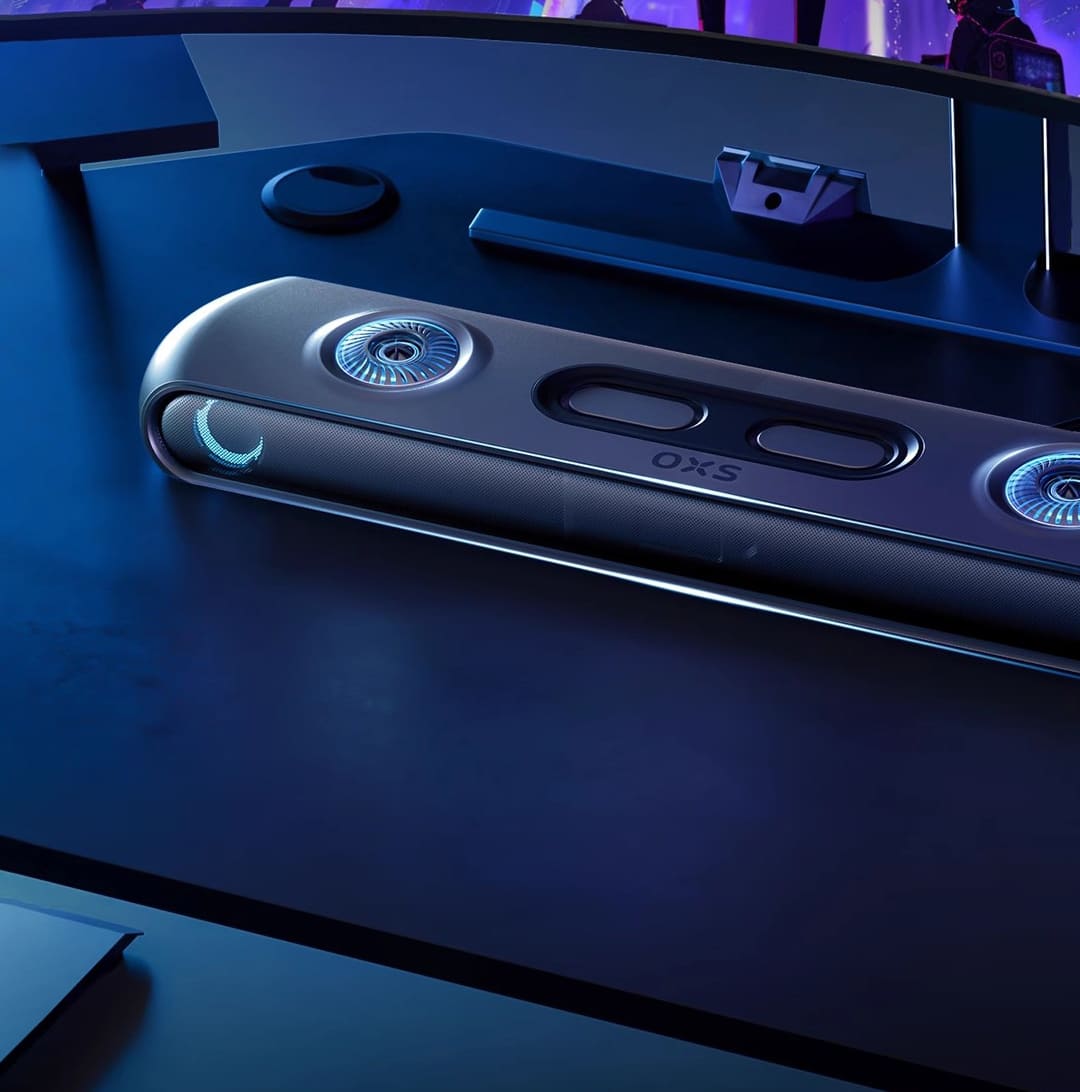
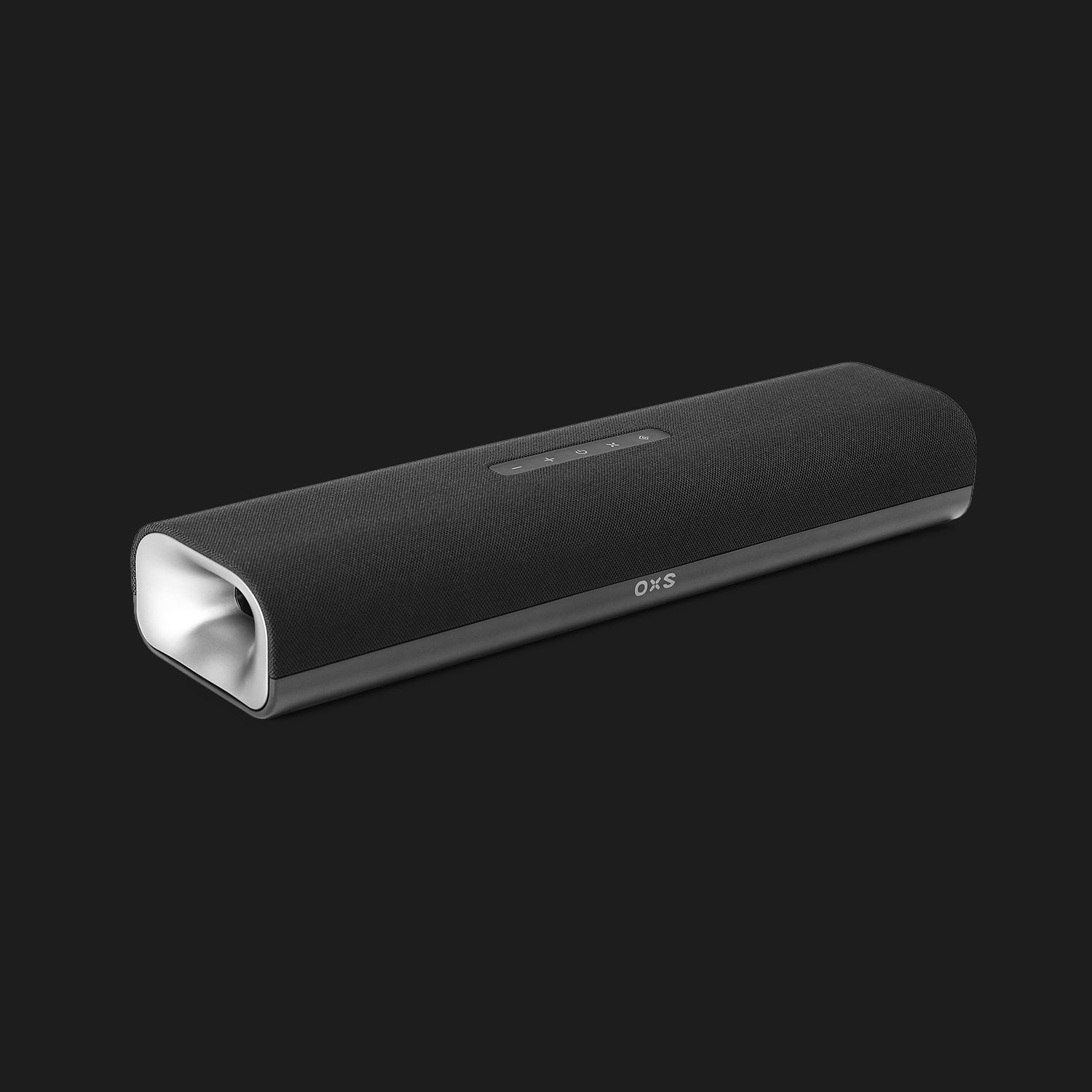
OXS Thunder Pro+ — the one that does it all ($699.99)
Out of the box, the Thunder Pro+ is a 2.1.2-channel bar: front channels, a wireless sub, and built-in up-firing height drivers — so the overhead layer is real from day one, not simulated. Add the 5.8 GHz wireless rear satellites and it expands into a full 7.1.2 system, which is a genuinely different experience for movies and a serious edge in games, where rear channels carry the spatial awareness.
What sells it beyond the channel count is how it’s tuned. This is a gaming-first system and it shows: dialogue stays crisp under a dense mix, and the sub is punchy rather than boomy — footsteps and explosions land with intent instead of dissolving into a wall of rumble. At $699.99 it sits under the premium flagships while delivering a configuration most of them reserve for $1,000-and-up models. If you want one system for both the living room and the desk, this is the pick (we dig into the desktop case in our gaming soundbar guide).
OXS Thunder Lite — the cheapest honest entry ($149.99)
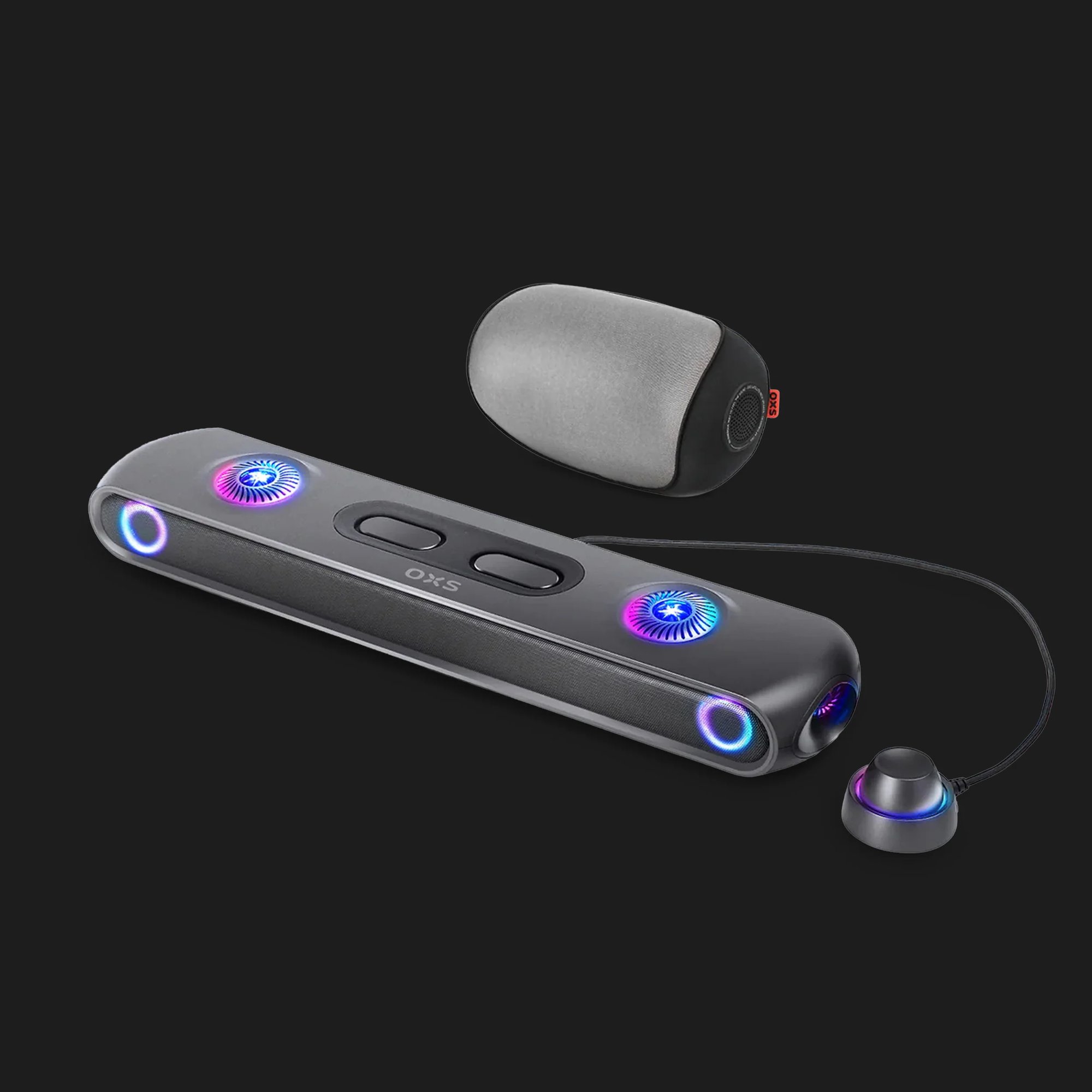
At $149.99, the Thunder Lite is the lowest-cost way into the line, and a more honest “Atmos” than many bars at twice the price. It’s a single compact bar — no separate sub or rears — so its height effect is naturally more restrained than the Pro+’s. But it decodes Atmos properly, and in a bedroom, a small apartment, or at a desk where the screen sits a couple of feet from your ears, the effect lands far better than its size suggests.
Think of it as the “is Atmos for me?” purchase. If you’re curious about spatial audio but don’t want to commit $500 before you’ve heard it, this is the low-risk on-ramp — and it’s good enough that plenty of people stop there.
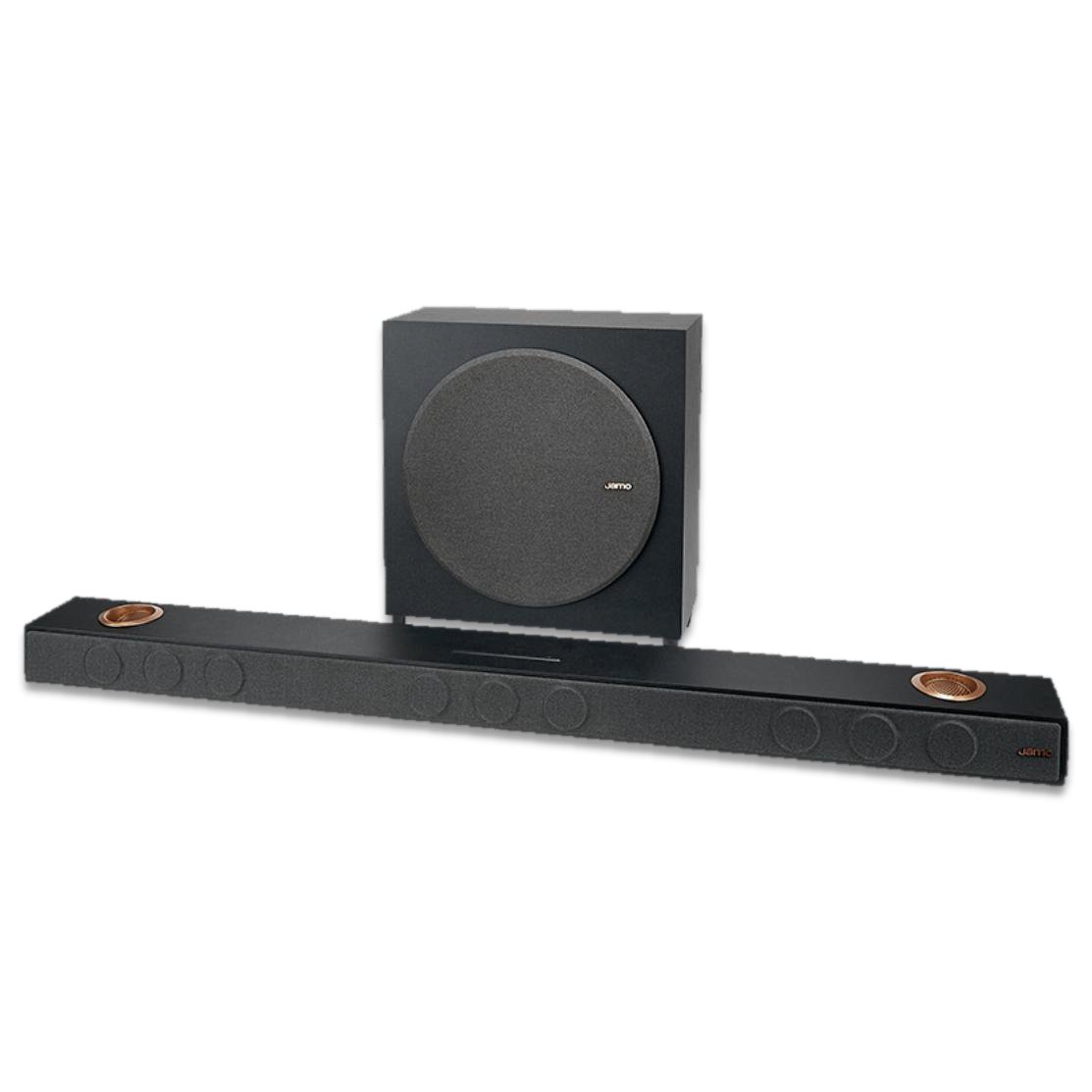
Jamo HCS B5 — the home-cinema anchor ($499)
Where the OXS bars are built around a screen, the Jamo HCS B5 is built around a room. It’s a true 5.1.2 system — five main channels, a wireless sub, and two up-firing height drivers — scaled for a proper living room rather than a desktop. Jamo’s decades of speaker design show up in the midrange: voices and acoustic instruments carry a warmth the gaming-tuned bars don’t chase.
At $499 it’s the anchor of this list — proof that a full 5.1.2 cinema system with real height channels can land under $500. If your Atmos ambition is movie night with the family rather than ranked matches, this is the one that earns the “cinema” in home cinema. It’s also the cleanest on-ramp to our 5.1.2 setup guide, which walks through placement without touching your ceiling.
The value benchmark — Vizio M-Series 5.1.2
No honest budget-Atmos list skips the product that made the category affordable in the first place. Vizio’s M-Series 5.1.2 has been the default answer for real up-firing Atmos under $500 for years — a bar with dedicated height drivers, a wireless sub, and rear satellites, typically street-priced in the $350–400 range. It isn’t the prettiest thing in the room and its app is forgettable, but as a pure dollars-per-height-channel proposition it still sets the floor everyone else has to clear. We mention it not to knock it — it’s the reason the category exists — but because it’s the reference point our own picks are measured against.
The mainstream default — Sonos Beam (Gen 2)
At $499, the Sonos Beam (Gen 2) is the bar most people will cross-shop, and it’s worth understanding what you’d be trading. It’s a single bar with no up-firing drivers — its Atmos is virtualized, steered across the front rather than bounced off the ceiling — and its strengths are elsewhere: best-in-class dialogue clarity, genuinely good music, and the most polished multi-room ecosystem going. For a small room or a music-first listener, it’s a lovely product. For someone who specifically wants to feel a helicopter pass overhead, a real up-firing system beats it every time. Different tools for different jobs.
How to pick
- Desk or games first? The Thunder Pro+ — or the Lite if you’re easing in.
- Living room, movie nights? The Jamo HCS B5.
- Tightest budget with a real Atmos badge? The Thunder Lite.
- Single bar plus a great music ecosystem, and height is negotiable? The Beam is fine — just know you’re buying dialogue and music, not overhead effects.
Two placement notes matter more than the box ever admits: up-firing drivers need a flat, hard ceiling roughly 2.4 to 3 meters high, and the bar needs to sit on a surface rather than hang angled down, so the reflection geometry actually works. Get those two things right and even a $150 bar sounds convincingly tall; get them wrong and a $700 system sounds like a nice stereo.
The verdict
If we had to name one pick, it’s the Thunder Pro+ — a real up-firing bar that grows into a full 7.1.2 system at a price that undercuts the flagships by hundreds. But the honest headline of this list is bigger than any single product: true Atmos has stopped being a luxury tier. You can now buy genuine overhead sound for less than the price of a games console — and that’s worth savoring before the big brands decide to raise the ceiling again.
Gear Radar is our editorial corner: buying guides, reviews and tutorials for people who care about how things sound. No sponsored rankings, ever.