Sennheiser Just Fixed the One Thing That Kills Every Pair of Earbuds
Dead batteries kill more wireless earbuds than anything else — and for years, the industry has treated that as your problem. The cells were glued shut, so when they gave out after a couple of years, the only move was the trash can. Sennheiser just proved it didn’t have to be this way.
The most disposable thing in your pocket
Wireless earbuds are among the most disposable products in tech. The batteries inside them are tiny — small enough to sit in your ear — so they get worked harder than almost any other cell you own. Every time a bud runs down and the case tops it back up, that’s a charge cycle. After a couple of years of daily use, most pairs stop holding enough charge to survive a commute.
The fix should be a ten-dollar battery and a screwdriver. Instead, the batteries are sealed with glue, the buds can’t be opened without destroying them, and the only real solution is to throw them out and buy new ones. We all quietly accepted it as the cost of going wireless. Roughly every three years, another pair lands in a drawer — or a landfill.
What Sennheiser actually changed
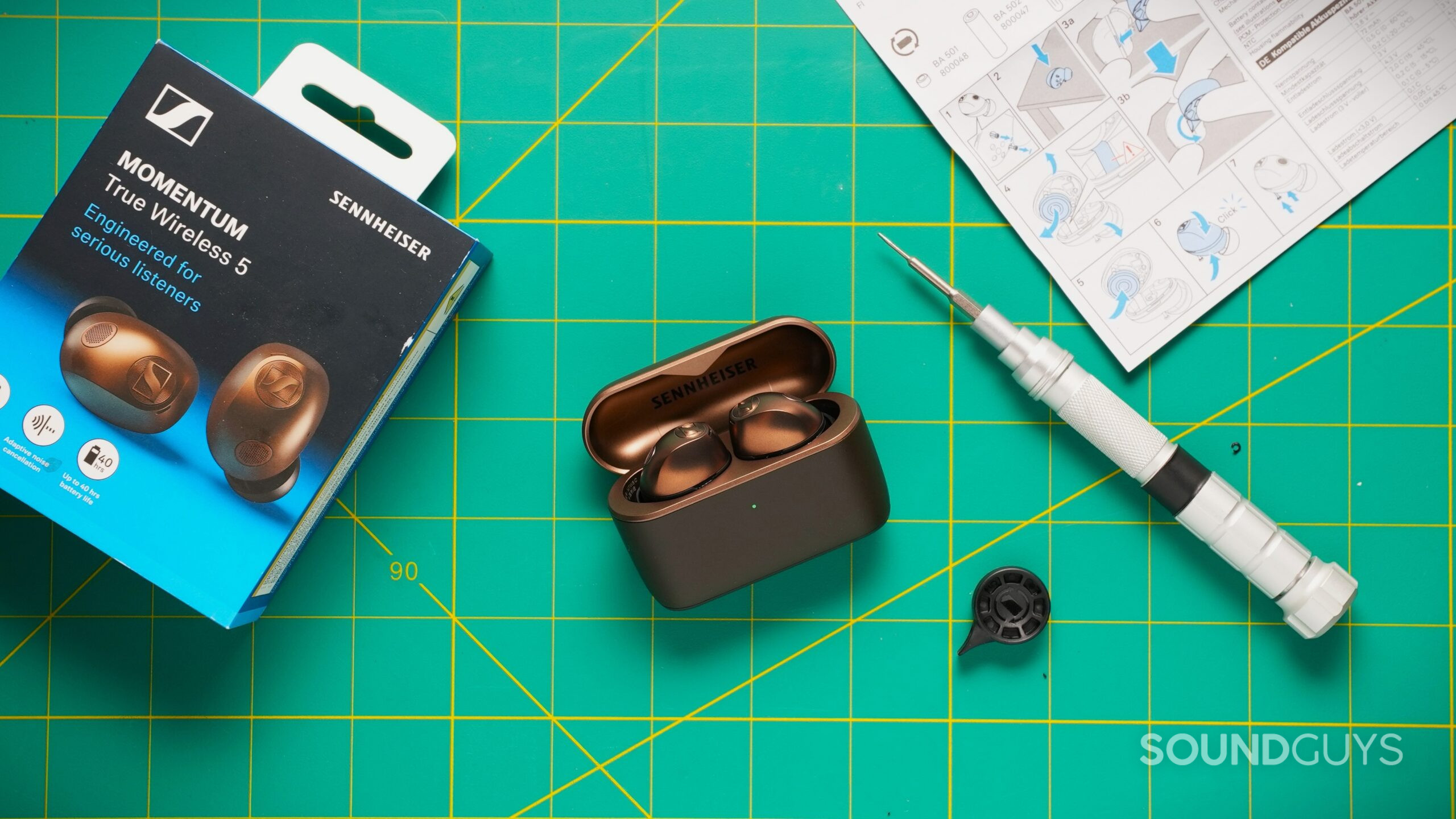
The Momentum True Wireless 5 makes the batteries in both the earbuds and the charging case user-replaceable. Unscrew the base of the case, swap the cells, done in a few minutes with a compact screwdriver — the same approach Sennheiser took with its Momentum 5 over-ear headphones. No service center, no trade-in program, no writing off a pair because a part the size of a fingernail wore out.
Why that matters: the first wave got it half right. Google’s Pixel Buds 2a made only the case battery replaceable, leaving the buds themselves — the part that degrades first — sealed. The Fairphone Fairbuds did both, but couldn’t match flagship sound and stumbled on app and connectivity. Sennheiser is the first to do both and keep premium performance: 12 hours of playback per charge, where most flagships manage six to eight, around 40 hours total with the case, and an 8-minute top-up that buys another hour.
The excuse is officially gone
Apple’s AirPods Pro, Bose’s QuietComfort Ultra Earbuds, Sony’s WF-1000XM6 — none of them have a reason left. Earbuds aren’t too small to service; some of those are bigger than Sennheiser’s. And there’s no shortage of demand: when SoundGuys asked readers whether all wireless headphones should have replaceable batteries, 97% said yes. That’s as close to unanimous as tech polling ever gets.
Sustainability is the next spec sheet line
This is part of a bigger shift. Repairability is turning from a nice-to-have into a feature people actually shop for. The momentum is coming from the same place that pushed repairable phones into the mainstream — the realization that “buy it, use it, bin it” is a design choice, not a law of physics.
House of Marley has been on this for a while, just from a different angle. Sound. Soul. Sustainability isn’t a tagline they bolt on — the hardware is built from bamboo, FSC-certified wood, and recycled composites like REWIND fabric, and every purchase funds reforestation through Project Marley. Different approach, same conviction: good sound shouldn’t cost the planet a pair of earbuds every three years.
Whether you buy the Sennheiser or not, the bar just moved. The next time a brand sells you sealed-shut earbuds, the real question isn’t the sound quality. It’s why the battery is your problem again.
Gear Radar is our editorial corner: buying guides, reviews and tutorials for people who care about how things sound. No sponsored rankings, ever.